" height="31.469717497114758px" id="eCOXNpv5s" transform="translate(0 8.53)" width="32.43161611406683px"/><path d="M 6.851 1.35 C 6.851 4.361 4.335 6.803 1.23 6.803 L 0 6.803 L 0 5.452 C 0 2.442 2.515 0 5.62 0 L 6.85 0 L 6.85 1.35 Z" fill="rgb(255, 87, 20)" height="6.8031511867128245px" id="yGyYVDzJf" transform="translate(16.216 0)" width="6.851178904096614px"/><path d="M 59.255 11.828 C 59.12 11.828 59.053 11.758 59.053 11.615 L 59.053 0.426 C 59.053 0.285 59.12 0.214 59.255 0.214 L 66.26 0.214 C 66.394 0.214 66.46 0.284 66.46 0.427 L 66.46 1.881 C 66.46 2.022 66.394 2.093 66.26 2.093 L 61.248 2.093 L 61.248 5.054 L 65.821 5.054 C 65.955 5.054 66.022 5.125 66.022 5.268 L 66.022 6.633 C 66.022 6.774 65.955 6.845 65.821 6.845 L 61.248 6.845 L 61.248 9.948 L 66.26 9.948 C 66.394 9.948 66.46 10.019 66.46 10.161 L 66.46 11.616 C 66.46 11.757 66.394 11.828 66.26 11.828 Z M 51.202 12.04 C 50.313 12.04 49.532 11.874 48.861 11.544 C 48.203 11.213 47.662 10.694 47.307 10.054 C 46.942 9.403 46.758 8.606 46.758 7.66 L 46.758 4.38 C 46.758 2.962 47.184 1.88 48.038 1.135 C 48.904 0.378 50.087 0 51.587 0 C 52.661 0 53.563 0.166 54.294 0.497 C 55.037 0.828 55.581 1.289 55.922 1.88 C 56.276 2.459 56.398 3.127 56.287 3.884 C 56.276 4.024 56.202 4.097 56.068 4.097 L 54.295 4.078 C 54.148 4.078 54.081 4.008 54.092 3.866 C 54.117 3.44 54.038 3.079 53.855 2.784 C 53.684 2.477 53.416 2.246 53.05 2.092 C 52.685 1.939 52.215 1.862 51.641 1.862 C 50.751 1.862 50.08 2.074 49.629 2.5 C 49.178 2.914 48.953 3.559 48.953 4.433 L 48.953 7.607 C 48.953 8.494 49.172 9.143 49.612 9.558 C 50.062 9.971 50.727 10.178 51.605 10.178 C 52.459 10.178 53.111 9.989 53.562 9.611 C 54.014 9.22 54.239 8.659 54.239 7.926 L 54.239 7.359 L 51.77 7.359 C 51.623 7.359 51.55 7.288 51.55 7.146 L 51.55 5.958 C 51.55 5.828 51.623 5.762 51.77 5.762 L 56.123 5.762 C 56.257 5.762 56.325 5.828 56.325 5.958 L 56.325 9.22 C 56.325 9.622 56.331 10.031 56.343 10.444 C 56.367 10.858 56.41 11.242 56.471 11.597 C 56.495 11.667 56.483 11.728 56.434 11.774 C 56.395 11.81 56.342 11.829 56.288 11.827 L 54.86 11.827 C 54.809 11.83 54.758 11.817 54.714 11.792 C 54.674 11.751 54.643 11.703 54.623 11.65 C 54.594 11.479 54.569 11.308 54.549 11.136 L 54.512 10.55 L 54.476 10.55 C 54.265 10.862 53.998 11.132 53.69 11.348 C 53.364 11.583 52.998 11.757 52.61 11.863 C 52.151 11.986 51.677 12.046 51.201 12.04 Z M 34.943 11.828 C 34.809 11.828 34.742 11.758 34.742 11.615 L 34.742 0.426 C 34.742 0.285 34.809 0.214 34.943 0.214 L 37.541 0.214 C 37.662 0.214 37.748 0.261 37.797 0.355 L 40.741 6.119 C 40.949 6.508 41.138 6.886 41.309 7.253 C 41.63 7.897 41.923 8.553 42.187 9.222 L 42.241 9.222 C 42.217 8.903 42.199 8.559 42.186 8.193 L 42.15 7.059 L 42.15 0.427 C 42.15 0.285 42.217 0.214 42.352 0.214 L 44.071 0.214 C 44.217 0.214 44.29 0.284 44.29 0.427 L 44.29 11.616 C 44.29 11.757 44.217 11.828 44.071 11.828 L 41.509 11.828 C 41.388 11.828 41.303 11.781 41.254 11.686 L 38.4 6.119 C 38.215 5.759 38.032 5.399 37.852 5.037 C 37.683 4.664 37.513 4.291 37.34 3.92 C 37.189 3.57 37.036 3.222 36.882 2.873 L 36.827 2.873 L 36.864 3.99 C 36.876 4.369 36.882 4.747 36.882 5.125 L 36.882 11.615 C 36.882 11.757 36.809 11.828 36.663 11.828 Z M 22.818 11.828 C 22.659 11.828 22.598 11.752 22.635 11.597 L 26.586 0.373 C 26.622 0.267 26.701 0.213 26.823 0.213 L 29.164 0.213 C 29.299 0.213 29.384 0.267 29.421 0.373 L 33.389 11.597 C 33.439 11.752 33.383 11.828 33.225 11.828 L 31.286 11.828 C 31.165 11.828 31.085 11.775 31.048 11.668 L 28.689 4.381 C 28.567 3.99 28.446 3.607 28.324 3.228 L 27.994 2.057 L 27.957 2.057 C 27.848 2.436 27.732 2.82 27.609 3.21 C 27.5 3.589 27.384 3.967 27.262 4.344 L 24.958 11.65 C 24.921 11.769 24.837 11.828 24.702 11.828 L 22.817 11.828 Z M 25.323 9.399 L 25.744 7.661 L 30.189 7.661 L 30.628 9.399 Z M 12.919 11.828 C 12.784 11.828 12.717 11.758 12.717 11.615 L 12.717 0.426 C 12.717 0.285 12.784 0.214 12.919 0.214 L 16.76 0.214 C 18.333 0.214 19.479 0.509 20.199 1.1 C 20.918 1.68 21.278 2.531 21.278 3.654 C 21.278 4.47 21.083 5.161 20.692 5.728 C 20.314 6.284 19.748 6.668 18.992 6.881 L 18.992 6.917 L 21.936 11.58 C 21.986 11.65 21.992 11.711 21.954 11.757 C 21.93 11.805 21.875 11.828 21.79 11.828 L 19.76 11.828 C 19.655 11.831 19.556 11.777 19.504 11.686 L 16.742 7.201 L 14.912 7.201 L 14.912 11.616 C 14.912 11.757 14.839 11.828 14.694 11.828 Z M 14.912 5.516 L 16.669 5.516 C 17.51 5.516 18.119 5.374 18.497 5.09 C 18.887 4.806 19.083 4.351 19.083 3.725 C 19.083 3.11 18.906 2.672 18.553 2.413 C 18.198 2.152 17.601 2.022 16.759 2.022 L 14.912 2.022 L 14.912 5.515 Z M 5.412 12.04 C 3.804 12.04 2.596 11.668 1.791 10.923 C 0.986 10.166 0.585 9.084 0.585 7.678 L 0.585 4.362 C 0.585 2.943 0.986 1.862 1.791 1.117 C 2.596 0.372 3.804 0 5.413 0 C 7.01 0 8.211 0.372 9.016 1.117 C 9.821 1.862 10.223 2.943 10.223 4.362 L 10.223 7.678 C 10.223 9.084 9.821 10.167 9.017 10.923 C 8.211 11.667 7.01 12.04 5.413 12.04 Z M 5.412 10.178 C 6.279 10.178 6.931 9.959 7.37 9.522 C 7.809 9.073 8.029 8.423 8.029 7.572 L 8.029 4.469 C 8.029 3.618 7.809 2.974 7.37 2.536 C 6.931 2.086 6.279 1.862 5.413 1.862 C 4.546 1.862 3.889 2.086 3.437 2.536 C 2.999 2.974 2.778 3.618 2.778 4.469 L 2.778 7.572 C 2.778 8.423 2.999 9.073 3.437 9.522 C 3.889 9.959 4.548 10.178 5.413 10.178 Z M 59.488 25.96 C 59.38 25.96 59.326 25.905 59.326 25.796 L 59.326 15.351 C 59.326 15.241 59.38 15.187 59.488 15.187 L 61.849 15.187 C 63.197 15.187 64.205 15.565 64.874 16.321 C 65.542 17.068 65.877 18.203 65.877 19.726 L 65.877 21.026 C 65.877 22.682 65.548 23.921 64.891 24.743 C 64.233 25.555 63.235 25.96 61.898 25.96 Z M 60.863 24.545 L 61.8 24.545 C 62.674 24.545 63.316 24.266 63.726 23.707 C 64.136 23.148 64.34 22.27 64.34 21.075 L 64.34 19.677 C 64.34 18.635 64.136 17.862 63.726 17.359 C 63.316 16.854 62.664 16.601 61.768 16.601 L 60.863 16.601 L 60.863 24.546 Z M 50.762 25.96 C 50.664 25.96 50.616 25.905 50.616 25.796 L 50.616 15.351 C 50.616 15.241 50.664 15.187 50.762 15.187 L 53.285 15.187 C 54.396 15.187 55.215 15.439 55.743 15.944 C 56.272 16.447 56.535 17.215 56.535 18.246 C 56.535 19.036 56.396 19.677 56.115 20.171 C 55.858 20.644 55.44 21.011 54.935 21.207 L 54.935 21.223 L 56.972 25.746 C 57.037 25.889 57 25.96 56.86 25.96 L 55.468 25.96 C 55.393 25.96 55.338 25.922 55.306 25.845 L 53.398 21.486 L 52.154 21.486 L 52.154 25.796 C 52.154 25.906 52.105 25.96 52.008 25.96 L 50.763 25.96 Z M 52.153 20.154 L 53.253 20.154 C 53.867 20.154 54.309 20.006 54.578 19.71 C 54.848 19.414 54.984 18.953 54.984 18.328 C 54.984 17.692 54.848 17.242 54.578 16.979 C 54.309 16.716 53.878 16.585 53.285 16.585 L 52.153 16.585 Z M 41.428 25.96 C 41.32 25.96 41.282 25.9 41.315 25.78 L 43.983 15.318 C 44.006 15.231 44.064 15.187 44.162 15.187 L 45.828 15.187 C 45.914 15.187 45.973 15.231 46.005 15.317 L 48.706 25.78 C 48.727 25.9 48.685 25.96 48.577 25.96 L 47.202 25.96 C 47.137 25.96 47.084 25.916 47.04 25.829 L 45.455 18.92 C 45.369 18.56 45.289 18.198 45.213 17.835 C 45.138 17.473 45.062 17.106 44.987 16.732 L 44.954 16.732 C 44.889 17.106 44.819 17.473 44.743 17.835 C 44.668 18.187 44.592 18.548 44.517 18.92 L 42.932 25.829 C 42.911 25.916 42.851 25.96 42.754 25.96 Z M 43.207 23.526 L 43.482 22.178 L 46.458 22.178 L 46.765 23.526 L 43.208 23.526 Z M 33.5 25.96 C 33.391 25.96 33.338 25.905 33.338 25.796 L 33.338 15.351 C 33.338 15.241 33.391 15.187 33.5 15.187 L 35.861 15.187 C 37.209 15.187 38.217 15.565 38.886 16.321 C 39.554 17.068 39.889 18.203 39.889 19.726 L 39.889 21.026 C 39.889 22.682 39.559 23.921 38.902 24.743 C 38.244 25.555 37.247 25.96 35.909 25.96 Z M 34.874 24.545 L 35.813 24.545 C 36.686 24.545 37.328 24.266 37.737 23.707 C 38.147 23.148 38.351 22.27 38.351 21.075 L 38.351 19.677 C 38.351 18.635 38.147 17.862 37.737 17.359 C 37.328 16.854 36.675 16.601 35.78 16.601 L 34.874 16.601 L 34.874 24.546 Z M 24.031 25.96 C 23.934 25.96 23.885 25.905 23.885 25.796 L 23.885 15.351 C 23.885 15.241 23.934 15.187 24.031 15.187 L 25.858 15.187 C 25.955 15.187 26.015 15.225 26.036 15.301 L 28.091 21.059 C 28.209 21.366 28.322 21.695 28.43 22.045 C 28.549 22.397 28.656 22.737 28.755 23.066 C 28.862 23.383 28.947 23.679 29.012 23.953 L 29.061 23.953 C 29.037 23.619 29.015 23.284 28.996 22.949 L 28.964 21.832 L 28.964 15.351 C 28.964 15.241 29.012 15.187 29.109 15.187 L 30.306 15.187 C 30.404 15.187 30.452 15.241 30.452 15.351 L 30.452 25.796 C 30.452 25.906 30.404 25.96 30.306 25.96 L 28.495 25.96 C 28.419 25.96 28.36 25.922 28.317 25.845 L 26.311 20.253 C 26.121 19.736 25.943 19.215 25.778 18.69 C 25.638 18.201 25.492 17.713 25.341 17.226 L 25.309 17.226 C 25.319 17.544 25.325 17.901 25.325 18.296 L 25.357 19.447 C 25.368 19.83 25.374 20.193 25.374 20.532 L 25.374 25.796 C 25.374 25.906 25.325 25.96 25.228 25.96 Z M 14.698 25.96 C 14.589 25.96 14.552 25.9 14.584 25.78 L 17.253 15.318 C 17.274 15.231 17.334 15.187 17.431 15.187 L 19.097 15.187 C 19.183 15.187 19.242 15.231 19.275 15.317 L 21.975 25.78 C 21.998 25.9 21.954 25.96 21.847 25.96 L 20.471 25.96 C 20.407 25.96 20.353 25.916 20.309 25.829 L 18.724 18.92 C 18.639 18.56 18.558 18.198 18.482 17.835 C 18.407 17.473 18.331 17.106 18.256 16.732 L 18.224 16.732 C 18.159 17.106 18.089 17.473 18.013 17.835 C 17.938 18.187 17.862 18.548 17.787 18.92 L 16.202 25.829 C 16.18 25.916 16.121 25.96 16.023 25.96 Z M 16.476 23.526 L 16.752 22.178 L 19.728 22.178 L 20.035 23.526 L 16.477 23.526 Z M 10.267 25.96 C 10.17 25.96 10.122 25.905 10.122 25.796 L 10.122 16.619 L 7.97 16.619 C 7.874 16.619 7.825 16.559 7.825 16.438 L 7.825 15.353 C 7.825 15.242 7.874 15.188 7.97 15.188 L 13.81 15.188 C 13.906 15.188 13.955 15.242 13.955 15.353 L 13.955 16.437 C 13.955 16.558 13.906 16.618 13.81 16.618 L 11.658 16.618 L 11.658 25.797 C 11.658 25.907 11.609 25.961 11.512 25.961 L 10.267 25.961 Z M 2.948 26.093 C 1.848 26.093 1.061 25.807 0.587 25.237 C 0.123 24.667 -0.066 23.91 0.02 22.967 C 0.03 22.814 0.085 22.737 0.182 22.737 L 1.378 22.737 C 1.487 22.737 1.54 22.814 1.54 22.968 C 1.498 23.548 1.6 23.987 1.848 24.282 C 2.107 24.568 2.495 24.711 3.013 24.711 C 3.52 24.711 3.892 24.595 4.128 24.365 C 4.366 24.135 4.485 23.773 4.485 23.28 C 4.485 23.027 4.452 22.802 4.387 22.605 C 4.32 22.403 4.209 22.218 4.063 22.062 C 3.897 21.877 3.7 21.721 3.481 21.602 L 1.751 20.566 C 1.169 20.204 0.743 19.803 0.473 19.365 C 0.215 18.915 0.09 18.367 0.101 17.72 C 0.111 16.854 0.355 16.195 0.829 15.746 C 1.314 15.285 2.015 15.055 2.932 15.055 C 3.946 15.055 4.706 15.324 5.212 15.861 C 5.729 16.387 5.945 17.134 5.859 18.099 C 5.838 18.263 5.784 18.345 5.697 18.345 L 4.469 18.345 C 4.361 18.345 4.317 18.263 4.34 18.098 C 4.383 17.582 4.281 17.183 4.033 16.898 C 3.796 16.602 3.44 16.453 2.965 16.453 C 2.545 16.453 2.222 16.558 1.995 16.766 C 1.769 16.963 1.655 17.27 1.655 17.687 C 1.645 18.071 1.72 18.389 1.881 18.64 C 2.043 18.882 2.313 19.112 2.69 19.333 L 4.372 20.351 C 4.782 20.592 5.105 20.851 5.343 21.124 C 5.59 21.388 5.769 21.695 5.876 22.046 C 5.985 22.385 6.038 22.797 6.038 23.28 C 6.038 24.168 5.79 24.858 5.294 25.352 C 4.798 25.846 4.016 26.092 2.949 26.092 Z" fill="rgb(23, 23, 23)" height="26.09262957451628px" id="G_jsIAzLG" transform="translate(40.54 11.039)" width="66.46047841033874px"/></g></svg>)
" height="31.469717497114758px" id="nxleYtm6x" transform="translate(1 8.53)" width="32.43161611406683px"/><path d="M 6.851 1.35 C 6.851 4.361 4.335 6.803 1.23 6.803 L 0 6.803 L 0 5.452 C 0 2.442 2.515 0 5.62 0 L 6.85 0 L 6.85 1.35 Z" fill="rgb(255, 87, 20)" height="6.8031511867128245px" id="ZZ56pTyUM" transform="translate(17.216 0)" width="6.851178904096614px"/></svg>)

Understanding money is one of the most valuable skills you can develop. Yet most people never stop to examine the fundamental principles behind the currencies they use every day.
Before the development of physical and digital currencies, early economic transactions involved bartering goods, marking the initial stage in the evolution of money.
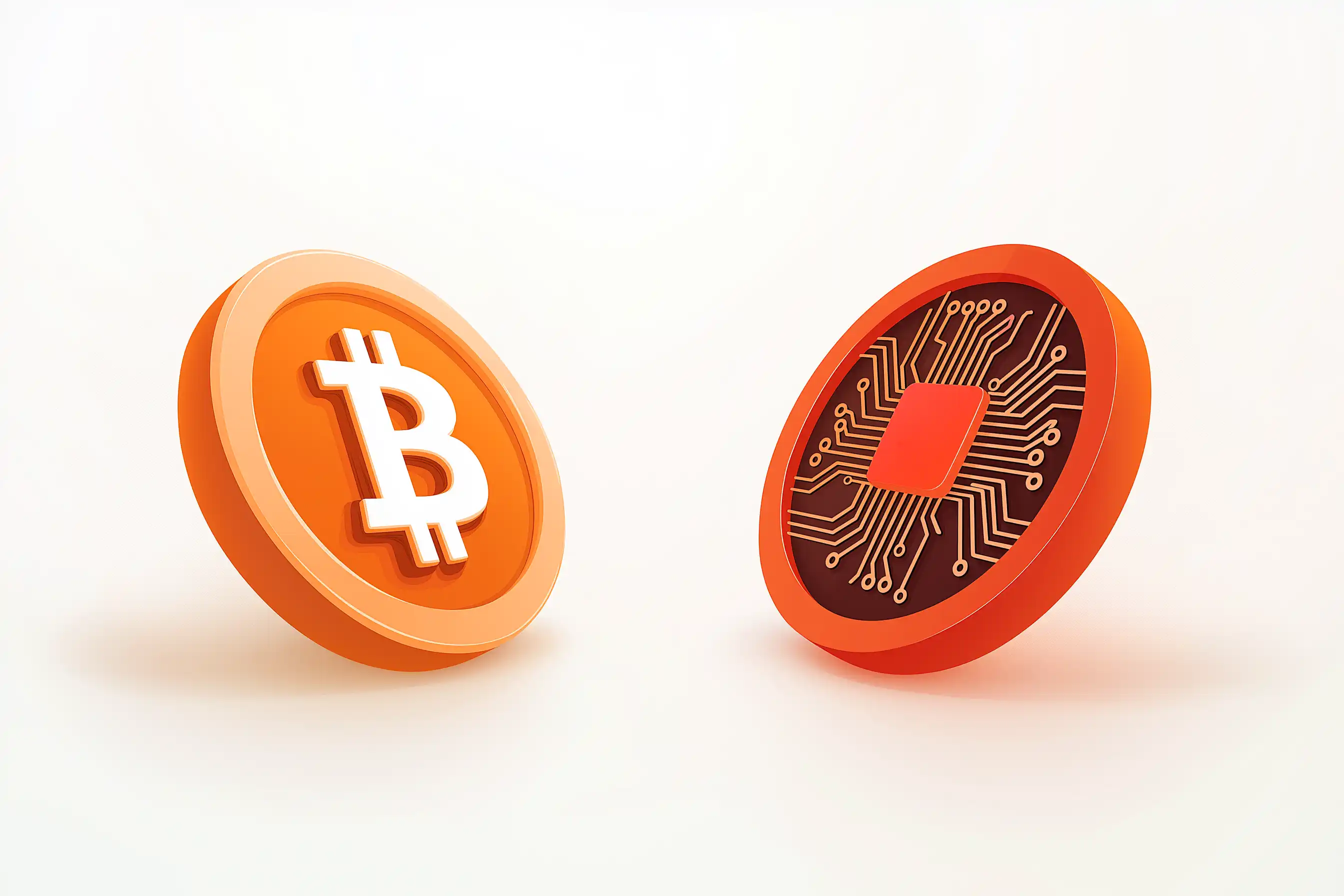
Fiat currency and Bitcoin represent two radically different approaches to money. One has evolved over centuries through government institutions and central banks. The other emerged in 2009 as a direct challenge to everything we thought we knew about monetary systems. Bitcoin's design is fundamentally different from fiat systems, emphasizing scarcity through its fixed supply and decentralization, in contrast to the flexible and centrally managed nature of fiat currencies.
In this guide, you’ll learn the core principles that separate these two monetary philosophies, from how they’re created and controlled to how they affect your purchasing power over time. Whether you’re evaluating your savings strategy or simply curious about the global financial system, understanding these key differences will help you navigate your financial future with clarity.
Quick Summary: Fiat Principles vs. Bitcoin Principles
Fiat money (USD, EUR, JPY, and similar currencies) derives its value from government authority and flexible monetary policy managed by central banks. In contrast, Bitcoin is a digital currency that operates independently of central authorities, existing entirely online and secured by cryptography and decentralized networks.
Bitcoin, launched on January 3, 2009, operates on an entirely different foundation: fixed rules encoded in software, decentralization across thousands of nodes, and a hard cap of 21 million coins that can never be changed.
Here’s how the core principles stack up:
Principle | Fiat Currency | Bitcoin |
Control | Centralized (governments and central banks) | Decentralized network of nodes and miners |
Supply | Elastic, can be expanded or contracted | Fixed supply of 21 million BTC |
Trust Model | Trust in institutions, laws, and regulatory bodies | Trust in open-source code and mathematical algorithms |
Censorship | Transactions can be frozen, reversed, or blocked | Censorship-resistant peer-to-peer payments |
Custody | Bank account controlled by financial institutions | Self custody via private keys |
How these principles play out in practice:
When the 2008 financial crisis hit, the Federal Reserve created trillions of new money through quantitative easing to stabilize the banking system. This is fiat’s flexibility principle in action, governments can respond to economic crises by adjusting the money supply.
Bitcoin’s response to time is entirely different. Its halving events (2012, 2016, 2020, 2024) reduce new supply by 50% on a predictable schedule that no single authority can alter. This reflects Bitcoin's design, which embodies programmatic scarcity, decentralization, and a finite supply.
These aren’t just technical differences. They represent fundamentally opposing philosophies about who should control money.
Foundations of Fiat Money
Fiat currency is government issued money that serves as legal tender by decree rather than by any physical backing. When you hold US dollar bills, euros, or yen, you’re holding paper money whose value comes entirely from public confidence in the issuing government and its institutions.
This might sound abstract, but it’s remarkably practical. The dollar in your pocket works because:
The government declares it legal tender
Businesses accept it for goods and services
You can pay taxes with it
Courts enforce contracts denominated in it
Modern fiat systems are managed by central banks like the Federal Reserve, European Central Bank, and Bank of Japan. These government institutions use sophisticated tools to influence the economy:
Interest rates: Raising or lowering the cost of borrowing
Quantitative easing: Purchasing bonds to inject liquidity
Reserve requirements: Dictating how much commercial banks must hold
Open market operations: Buying and selling government securities
Historical Context
The path to today’s fiat systems wasn’t straight:
11th century China: Early paper bills emerged as receipts for deposited precious metals
19th-20th century: The gold standard tied major currencies to gold reserves
1971: President Nixon ended the US dollar’s convertibility to gold, completing the transition to pure fiat
This final break from the gold standard gave governments unprecedented flexibility. Central bank policies could now respond to wars, recessions, pandemics, and financial crises without being constrained by gold reserves.
The core principle of fiat is flexibility through centralized control. Governments can create more money when they believe it’s needed, a power that can stabilize economies during crises but also carries the risk of inflation when overused.
Over 92% of global money now exists in digital form rather than as physical cash or physical coins. Modern banking has evolved far beyond paper money in vaults.
Gold Standard History
Before the era of fiat currency, many nations operated under the gold standard, a system where the value of money was directly tied to a fixed quantity of gold. Under this arrangement, governments issued paper money that could be exchanged for a specific amount of gold held in reserve. This linkage meant that the supply of currency was constrained by the amount of gold a country possessed, making it difficult for governments to create more money at will.
The gold standard played a crucial role in helping countries control inflation and maintain the value of their currency. Because governments couldn’t simply print more money without increasing their gold reserves, the risk of runaway inflation was minimized. This system fostered public confidence in the stability and value of money, as people knew their currency was backed by a tangible asset.
However, the gold standard also had significant limitations. During economic crises, governments found themselves unable to respond flexibly, if they needed to stimulate the economy, they couldn’t just issue more money without risking a run on their gold reserves. This inflexibility became especially problematic during major events like wars and global recessions.
By the mid-20th century, most countries abandoned the gold standard in favor of fiat currency systems. The shift allowed governments to manage the money supply more dynamically, using tools like interest rates and quantitative easing to address economic challenges. While this transition increased the risk of inflation, it also gave policymakers the flexibility to respond to crises and support economic growth, trade-offs that continue to shape debates about the best way to manage money and value in the modern world.
Banking System Overview
The banking system forms the backbone of the global financial system, playing a crucial role in facilitating transactions, managing risk, and supporting economic growth. At its core, the system is made up of commercial banks and central banks, each with distinct but interconnected responsibilities.
Commercial banks are the institutions most people interact with daily. They accept deposits, provide loans, and offer a range of financial services to individuals and businesses. By lending out a portion of the deposits they receive, a practice known as fractional reserve banking, commercial banks effectively create new money, expanding the money supply and fueling economic activity. This ability to generate new money is a defining feature of modern fiat currency systems.
Central banks, such as the Federal Reserve or the European Central Bank, oversee the broader money supply and set key interest rates that influence borrowing and lending across the economy. They act as regulators, ensuring the stability of the banking system and intervening when necessary to prevent financial crises. Central banks also serve as lenders of last resort, providing liquidity to commercial banks in times of stress.
Trust is fundamental to the banking system. Depositors rely on banks to safeguard their money, while banks depend on borrowers to repay loans. However, the system is not without risks, bank failures or loss of confidence can have far-reaching consequences, sometimes triggering broader economic instability or inflation.
In recent years, the rise of digital assets and decentralized financial systems has begun to challenge traditional banking models. Innovations like cryptocurrencies and blockchain technology offer new ways to transfer value and manage money outside the conventional banking system, prompting both excitement and debate about the future of finance. As these new financial systems evolve, they continue to reshape how money, trust, and value are managed in the global economy.
Fiat Money Characteristics
Fiat money is a form of currency that holds value not because of any physical backing, such as gold or silver, but because governments and central banks declare it to be legal tender. This means that fiat currency, like the US dollar, euro, or yen, is accepted for all debts and transactions within a country simply by government decree. Unlike commodities or precious metals, fiat money has no intrinsic value; its worth is derived entirely from the trust and confidence that people place in the issuing government and its ability to maintain economic stability.
A defining characteristic of fiat money is its flexibility, governments and central banks have the authority to increase or decrease the money supply as needed to respond to economic conditions. This power allows them to manage inflation, stimulate growth, or address financial crises. However, this same flexibility can also lead to economic instability if the money supply is not managed responsibly. Excessive creation of new money can erode public confidence, leading to inflation or even hyperinflation, which diminishes the value of the currency and reduces purchasing power.
In today’s global financial system, fiat currency is the standard, underpinning everything from daily transactions to international trade. Its value is ultimately a reflection of public confidence in the issuing government’s stability and monetary policies, rather than any physical asset or intrinsic worth.
Foundations of Bitcoin
Bitcoin emerged from a nine-page white paper published by the pseudonymous Satoshi Nakamoto on October 31, 2008. The network launched on January 3, 2009, with the Genesis block containing a now-famous headline from The Times: “Chancellor on brink of second bailout for banks.”
This wasn’t accidental. Bitcoin was designed as a decentralized alternative to the traditional financial system that had just failed spectacularly.
Core Design Principles
Bitcoin’s architecture embodies several non-negotiable principles:
Peer-to-peer electronic cash: Transactions flow directly between parties without requiring trusted intermediaries like banks or payment processors.
Censorship resistance: No central authority can freeze your funds or block your transactions. If you control your private keys, you control your Bitcoin.
Predictable monetary schedule: New Bitcoins enter circulation through mining, with rewards halving approximately every four years:
Halving Event | Block Reward | Daily New BTC |
2009 (Launch) | 50 BTC | ~7,200 |
2012 | 25 BTC | ~3,600 |
2016 | 12.5 BTC | ~1,800 |
2020 | 6.25 BTC | ~900 |
2024 | 3.125 BTC | ~450 |
This schedule enforces a limited supply that will never exceed 21 million BTC, a finite amount hardcoded into the protocol.
Trust in code, not institutions: Bitcoin’s blockchain technology creates a publicly verifiable record of every transaction since 2009. Anyone can run a full node and verify the entire history without trusting a central authority.
The principle here is fundamentally different from fiat: trust in cryptographic code and mathematical algorithms rather than in governments and central banks.
Digital Assets Overview
Digital assets, such as cryptocurrencies and other blockchain-based tokens, represent a decentralized alternative to traditional fiat currency. Unlike government-issued money, digital assets operate on decentralized networks powered by blockchain technology and secured by cryptographic code. This means that transactions and the creation of new units are governed by transparent, algorithmic rules rather than the decisions of central banks or governments.
One of the key differences between digital assets and fiat currency is the concept of limited supply. Many digital assets, including Bitcoin, are designed with a fixed or predictable issuance schedule, making them attractive as a potential store of value. Blockchain technology ensures that all transactions are recorded on a public ledger, providing transparency and reducing the risk of manipulation.
Digital assets have gained significant attention in recent years due to their potential for high returns, their role as a hedge against inflation, and their ability to facilitate peer-to-peer transactions without the need for intermediaries. However, they also come with unique risks, such as price volatility and evolving regulatory frameworks. Understanding these key differences is essential for anyone looking to navigate the rapidly changing landscape of money and value in the digital age.
Core Principles: Fiat vs Bitcoin Side by Side
This is the heart of the comparison, not just listing features, but understanding the philosophical foundations that make these systems behave so differently.
Monetary Policy Principle
Fiat: Discretionary and managed. Central banks adjust interest rates based on economic conditions, targeting specific outcomes like 2% annual inflation or maximum employment. The Federal Reserve’s response to COVID-19 in 2020 demonstrated this flexibility, adjusting interest rates to near zero and expanding the money supply dramatically.
Bitcoin: Algorithmic and immutable. The issuance schedule was set in 2009 and cannot be changed without consensus from the entire network. There’s no Fed meeting to decide how much Bitcoin should exist. The protocol simply follows its predetermined rules.
Governance Principle
Fiat: Top-down through elected officials, finance ministries, and appointed central bank boards. Monetary policies are set by small groups of experts who may or may not face political pressure.
Bitcoin: Bottom-up through open-source development and node consensus. Changes require widespread agreement across developers, miners, and users. No single authority can unilaterally alter the rules.
Trust Principle
Fiat: Trust in institutions and legal tender laws. You trust that your bank will honor withdrawals, that the government won’t hyperinflate, and that courts will enforce contracts.
Bitcoin: “Don’t trust, verify.” Anyone can run a full node, audit the complete transaction history, and confirm the total supply. The system is designed so verification replaces trust.
Custody and Control Principle
Fiat: Your bank account is a claim on funds held by a financial institution. This enables conveniences (password resets, fraud protection) but also risks:
Greece 2015: Capital controls limited ATM withdrawals to €60/day
Canada 2022: Bank accounts frozen during trucker protests
Routine: KYC requirements, transaction monitoring, potential account closure
Bitcoin: Self custody means you hold private keys that control your funds directly. No intermediary can freeze or seize coins you properly secure. The trade-off: lose your keys, lose your Bitcoin permanently.
Legal and Monetary Sovereignty Principle
Fiat: Tied to nation-states. The US dollar is legal tender in America, the euro in the Eurozone. Cross border payments often involve currency conversion, correspondent banking, and regulatory compliance.
Bitcoin: Borderless by nature means the protocol works identically whether you’re in the United States, Nigeria, Argentina, or anywhere with internet access. One Bitcoin in Tokyo is the same as one Bitcoin in Toronto.
Economic Characteristics: Inflation, Scarcity, and Volatility
Fiat and Bitcoin embody opposite philosophies about inflation and scarcity. These differences directly affect how your savings behave over time.
Inflation in Fiat
Central banks typically target around 2% annual inflation as “healthy” for economic growth. This means fiat supply is designed to expand over time, deliberately eroding purchasing power.
In practice, inflation isn’t always controlled:
2022: US CPI spiked above 8%, driven by pandemic-era money creation and supply chain issues
Venezuela: Hyperinflation rendered the bolivar nearly worthless
Zimbabwe: Famous for trillion-dollar notes that couldn’t buy bread
When governments print more money than the economy can absorb, holders of that currency watch their savings lose value. This is the risk side of fiat’s flexibility principle.
Bitcoin’s Scarcity
Bitcoin takes the opposite approach. Rather than manage inflation through policy decisions, the protocol enforces a decreasing issuance rate through halvings.
After the 2024 halving, only 3.125 new Bitcoins enter circulation per block (roughly every 10 minutes). The total fiat supply can expand indefinitely. The total Bitcoin supply cannot exceed 21 million.
This creates what some call a “deflationary” tendency, though technically, Bitcoin’s supply still grows slowly until approximately 2140 when the final satoshi will be mined.
Stability vs. Volatility
Fiat currencies (especially major ones like USD, EUR, JPY) tend to move gradually against each other, barring economic instability or crisis.
Bitcoin has experienced dramatic price cycles:
Under $1,000 in early 2013
Nearly $20,000 in December 2017
Around $69,000 peak in November 2021
Sharp drawdowns of 50-80% during bear markets
This volatility reflects Bitcoin’s smaller market size, speculative interest, and ongoing price discovery as a new asset class. It’s a key consideration for anyone evaluating Bitcoin as a store of value.
Wealth Preservation Trade-offs
Holding savings in a bank account denominated in fiat subjects you to inflation risk. Your nominal balance stays the same, but purchasing power erodes over time.
Holding Bitcoin exposes you to volatility risk. Your purchasing power could increase dramatically, or drop sharply, over shorter timeframes.
Neither approach is universally “correct.” The right choice depends on your time horizon, risk tolerance, and financial goals.
Digital Currency Advantages
Digital currencies, including cryptocurrencies, offer several compelling advantages over traditional fiat currency. One of the most notable benefits is the ability to conduct fast and low-cost transactions, regardless of geographic location. Whether sending money across the street or across the globe, digital currencies can facilitate transfers in minutes, often with lower fees than those charged by banks or payment processors.
Security is another major advantage. Digital currencies use advanced cryptographic techniques to secure transactions and control the creation of new units, making it extremely difficult for unauthorized parties to alter or counterfeit the currency. Additionally, all transactions are publicly verifiable on a blockchain ledger, which enhances transparency and accountability. This open record-keeping helps reduce the risk of fraud and corruption, as anyone can audit the transaction history.
By combining speed, security, and transparency, digital currencies present a modern alternative to fiat currency, offering users greater control and confidence in their financial transactions.
Operational Principles: Custody, Settlement, and Transparency
Beyond monetary theory, fiat and Bitcoin differ substantially in how people actually hold and move value day to day.
Custody in Fiat
The traditional financial system relies on layers of intermediaries:
Commercial banks hold deposits
Payment processors (Visa, Mastercard) facilitate card transactions
Clearinghouses settle trades between financial institutions
SWIFT enables international wire transfers
When you check your bank account balance, you’re seeing a claim on funds the bank owes you, not direct control over underlying assets. This structure enables consumer protections (chargebacks, fraud recovery, FDIC insurance) but means a third party always stands between you and your money.
Custody in Bitcoin
Bitcoin enables direct ownership through cryptographic keys:
Private keys: Secret codes that authorize spending
Hardware wallets: Physical devices storing keys offline
Non-custodial software: Apps that keep you in control
The trade-off is stark. Forget your bank password? Reset it. Lose your Bitcoin private keys? Those coins are gone forever. Self custody demands responsibility that fiat banking systems deliberately remove.
Settlement Finality
Fiat: Cross border payments can take 3-5 business days through correspondent banks. Domestic ACH transfers often settle next-day. Credit card transactions involve provisional credits that can be reversed.
Bitcoin: On-chain settlement typically achieves sufficient confirmation within 10-60 minutes. The transaction speed depends on network conditions and fees paid. Once confirmed, transactions are practically irreversible.
Transparency Principle
Fiat: Central bank balance sheets are published periodically, but banking ledgers remain private. You can’t independently verify the money supply or audit where newly created money flows.
Bitcoin: The blockchain is publicly verifiable in real time. Anyone can:
Confirm the total supply of Bitcoin in existence
Trace any transaction back to the Genesis block
Verify that protocol rules are being followed
This transparency comes with privacy trade-offs, transactions are pseudonymous but not anonymous, and sophisticated analysis can sometimes link addresses to identities.
Crypto Transactions Security
Crypto transactions are protected by a combination of advanced cryptographic techniques and decentralized blockchain technology. Each transaction is secured using mathematical algorithms and digital signatures, ensuring that only the rightful owner can authorize the movement of funds. Once a transaction is broadcast to the network, it is verified and recorded on a public blockchain ledger, which is maintained by a distributed network of computers rather than a single central authority.
This decentralized approach means that no single entity can alter, delete, or manipulate transaction records, providing a high level of security and trust. The use of blockchain technology ensures that every transaction is transparent and tamper-proof, while the underlying cryptographic code makes it virtually impossible for hackers to forge or reverse transactions. As a result, crypto transactions offer a robust and secure alternative to traditional payment systems, with security rooted in mathematics and decentralized consensus rather than institutional oversight.
Societal and Regulatory Context
Fiat and Bitcoin don’t exist in isolation. They coexist within complex legal, social, and regulatory frameworks that continue evolving.
Legal Status
Fiat: Established as legal tender by law in their respective jurisdictions. The US dollar must be accepted for debts in America. The euro serves this function across the Eurozone.
Bitcoin’s legal status varies dramatically:
El Salvador (2021): Became legal tender alongside the dollar
United States: Treated as property for tax purposes
China: Banned crypto transactions
Many countries: Legal to hold, uncertain regulatory status
Regulatory Frameworks
The banking system operates under decades of accumulated regulation:
Deposit insurance (FDIC in the US)
Consumer protection laws
Anti-money laundering requirements
Capital adequacy standards
Regular examinations and audits
Bitcoin regulation is still developing. Governments are establishing rules around:
Cryptocurrency exchange licensing
Tax reporting for crypto transactions
Anti-money laundering compliance
Bitcoin ETF approvals (approved in the US in January 2024)
Financial Inclusion and Control
Fiat systems can exclude people:
The unbanked lack access to basic financial services
Capital controls can trap citizens’ wealth within borders
Sanctions can disconnect entire nations from the global economy
Bitcoin offers access to anyone with a smartphone and internet connection, no bank account required. However, using it effectively demands technical literacy and personal responsibility that fiat systems deliberately abstract away.
A World of Parallel Systems
These different principles suggest a future where both systems coexist rather than one replacing the other entirely. Individuals and businesses will choose between digital assets and traditional finance, or use both, based on:
Jurisdiction and local regulations
Risk tolerance
Technical capability
Specific use cases (daily spending vs. long-term savings)
Financial Future Outlook
The financial future is being reshaped by the rapid rise of digital assets and the ongoing evolution of the global economy. As digital currencies and decentralized networks gain traction, we are witnessing a shift away from exclusive reliance on traditional fiat currency and the centralized control of central banks. This transformation is prompting governments and central banks to rethink their monetary policies and regulatory frameworks to address both the opportunities and challenges presented by digital assets.
In the coming years, it is likely that digital assets will play an increasingly prominent role in financial transactions, savings, and investment strategies. The global economy may see a blend of traditional fiat currency and innovative digital assets, with individuals and institutions choosing the best tools for their needs. Central banks and governments will need to adapt by developing new policies that balance innovation with stability and security.
Ultimately, the future of finance will be shaped by the interplay of technology, economics, and regulation. Staying informed and adaptable will be crucial for anyone looking to navigate this dynamic landscape, as the boundaries between fiat currency and digital assets continue to blur and redefine the way we think about money, value, and transactions.
Conclusion: Two Competing Monetary Philosophies
Fiat currency is built on centralized control, political decision-making, and legal authority. Governments and central banks retain flexibility to adjust the money supply, manage inflation, and respond to economic crises through coordinated policy.
Bitcoin is built on fixed rules, decentralization, and cryptographic assurance. Its supply schedule is immutable, its transactions are censorship-resistant, and its ledger is publicly verifiable by anyone willing to run a node.
Neither system is perfect:
Fiat offers stability, integration with existing financial institutions, and consumer protections, but remains vulnerable to inflation, policy errors, and government overreach.
Bitcoin offers scarcity, transparency, and monetary sovereignty, but comes with volatility, self custody risks, and a steeper learning curve.
Another important consideration is the environmental impact. Bitcoin mining is known for its high energy consumption, which is significantly greater than that of traditional financial systems.
When evaluating how to balance fiat and Bitcoin in your financial life, focus on the principles: Who controls the money? How is supply decided? How transparent is the system? What are the custody trade-offs?
Both sets of principles will continue shaping innovation in payments, savings, and the global economy through the 2020s and beyond. Understanding them isn’t just academic, it’s essential knowledge for navigating your financial future in an era where new money competes with the old.
The question isn’t whether fiat or Bitcoin will “win.” It’s which principles matter most to you, and how you’ll structure your finances accordingly.