" height="31.469717497114758px" id="eCOXNpv5s" transform="translate(0 8.53)" width="32.43161611406683px"/><path d="M 6.851 1.35 C 6.851 4.361 4.335 6.803 1.23 6.803 L 0 6.803 L 0 5.452 C 0 2.442 2.515 0 5.62 0 L 6.85 0 L 6.85 1.35 Z" fill="rgb(255, 87, 20)" height="6.8031511867128245px" id="yGyYVDzJf" transform="translate(16.216 0)" width="6.851178904096614px"/><path d="M 59.255 11.828 C 59.12 11.828 59.053 11.758 59.053 11.615 L 59.053 0.426 C 59.053 0.285 59.12 0.214 59.255 0.214 L 66.26 0.214 C 66.394 0.214 66.46 0.284 66.46 0.427 L 66.46 1.881 C 66.46 2.022 66.394 2.093 66.26 2.093 L 61.248 2.093 L 61.248 5.054 L 65.821 5.054 C 65.955 5.054 66.022 5.125 66.022 5.268 L 66.022 6.633 C 66.022 6.774 65.955 6.845 65.821 6.845 L 61.248 6.845 L 61.248 9.948 L 66.26 9.948 C 66.394 9.948 66.46 10.019 66.46 10.161 L 66.46 11.616 C 66.46 11.757 66.394 11.828 66.26 11.828 Z M 51.202 12.04 C 50.313 12.04 49.532 11.874 48.861 11.544 C 48.203 11.213 47.662 10.694 47.307 10.054 C 46.942 9.403 46.758 8.606 46.758 7.66 L 46.758 4.38 C 46.758 2.962 47.184 1.88 48.038 1.135 C 48.904 0.378 50.087 0 51.587 0 C 52.661 0 53.563 0.166 54.294 0.497 C 55.037 0.828 55.581 1.289 55.922 1.88 C 56.276 2.459 56.398 3.127 56.287 3.884 C 56.276 4.024 56.202 4.097 56.068 4.097 L 54.295 4.078 C 54.148 4.078 54.081 4.008 54.092 3.866 C 54.117 3.44 54.038 3.079 53.855 2.784 C 53.684 2.477 53.416 2.246 53.05 2.092 C 52.685 1.939 52.215 1.862 51.641 1.862 C 50.751 1.862 50.08 2.074 49.629 2.5 C 49.178 2.914 48.953 3.559 48.953 4.433 L 48.953 7.607 C 48.953 8.494 49.172 9.143 49.612 9.558 C 50.062 9.971 50.727 10.178 51.605 10.178 C 52.459 10.178 53.111 9.989 53.562 9.611 C 54.014 9.22 54.239 8.659 54.239 7.926 L 54.239 7.359 L 51.77 7.359 C 51.623 7.359 51.55 7.288 51.55 7.146 L 51.55 5.958 C 51.55 5.828 51.623 5.762 51.77 5.762 L 56.123 5.762 C 56.257 5.762 56.325 5.828 56.325 5.958 L 56.325 9.22 C 56.325 9.622 56.331 10.031 56.343 10.444 C 56.367 10.858 56.41 11.242 56.471 11.597 C 56.495 11.667 56.483 11.728 56.434 11.774 C 56.395 11.81 56.342 11.829 56.288 11.827 L 54.86 11.827 C 54.809 11.83 54.758 11.817 54.714 11.792 C 54.674 11.751 54.643 11.703 54.623 11.65 C 54.594 11.479 54.569 11.308 54.549 11.136 L 54.512 10.55 L 54.476 10.55 C 54.265 10.862 53.998 11.132 53.69 11.348 C 53.364 11.583 52.998 11.757 52.61 11.863 C 52.151 11.986 51.677 12.046 51.201 12.04 Z M 34.943 11.828 C 34.809 11.828 34.742 11.758 34.742 11.615 L 34.742 0.426 C 34.742 0.285 34.809 0.214 34.943 0.214 L 37.541 0.214 C 37.662 0.214 37.748 0.261 37.797 0.355 L 40.741 6.119 C 40.949 6.508 41.138 6.886 41.309 7.253 C 41.63 7.897 41.923 8.553 42.187 9.222 L 42.241 9.222 C 42.217 8.903 42.199 8.559 42.186 8.193 L 42.15 7.059 L 42.15 0.427 C 42.15 0.285 42.217 0.214 42.352 0.214 L 44.071 0.214 C 44.217 0.214 44.29 0.284 44.29 0.427 L 44.29 11.616 C 44.29 11.757 44.217 11.828 44.071 11.828 L 41.509 11.828 C 41.388 11.828 41.303 11.781 41.254 11.686 L 38.4 6.119 C 38.215 5.759 38.032 5.399 37.852 5.037 C 37.683 4.664 37.513 4.291 37.34 3.92 C 37.189 3.57 37.036 3.222 36.882 2.873 L 36.827 2.873 L 36.864 3.99 C 36.876 4.369 36.882 4.747 36.882 5.125 L 36.882 11.615 C 36.882 11.757 36.809 11.828 36.663 11.828 Z M 22.818 11.828 C 22.659 11.828 22.598 11.752 22.635 11.597 L 26.586 0.373 C 26.622 0.267 26.701 0.213 26.823 0.213 L 29.164 0.213 C 29.299 0.213 29.384 0.267 29.421 0.373 L 33.389 11.597 C 33.439 11.752 33.383 11.828 33.225 11.828 L 31.286 11.828 C 31.165 11.828 31.085 11.775 31.048 11.668 L 28.689 4.381 C 28.567 3.99 28.446 3.607 28.324 3.228 L 27.994 2.057 L 27.957 2.057 C 27.848 2.436 27.732 2.82 27.609 3.21 C 27.5 3.589 27.384 3.967 27.262 4.344 L 24.958 11.65 C 24.921 11.769 24.837 11.828 24.702 11.828 L 22.817 11.828 Z M 25.323 9.399 L 25.744 7.661 L 30.189 7.661 L 30.628 9.399 Z M 12.919 11.828 C 12.784 11.828 12.717 11.758 12.717 11.615 L 12.717 0.426 C 12.717 0.285 12.784 0.214 12.919 0.214 L 16.76 0.214 C 18.333 0.214 19.479 0.509 20.199 1.1 C 20.918 1.68 21.278 2.531 21.278 3.654 C 21.278 4.47 21.083 5.161 20.692 5.728 C 20.314 6.284 19.748 6.668 18.992 6.881 L 18.992 6.917 L 21.936 11.58 C 21.986 11.65 21.992 11.711 21.954 11.757 C 21.93 11.805 21.875 11.828 21.79 11.828 L 19.76 11.828 C 19.655 11.831 19.556 11.777 19.504 11.686 L 16.742 7.201 L 14.912 7.201 L 14.912 11.616 C 14.912 11.757 14.839 11.828 14.694 11.828 Z M 14.912 5.516 L 16.669 5.516 C 17.51 5.516 18.119 5.374 18.497 5.09 C 18.887 4.806 19.083 4.351 19.083 3.725 C 19.083 3.11 18.906 2.672 18.553 2.413 C 18.198 2.152 17.601 2.022 16.759 2.022 L 14.912 2.022 L 14.912 5.515 Z M 5.412 12.04 C 3.804 12.04 2.596 11.668 1.791 10.923 C 0.986 10.166 0.585 9.084 0.585 7.678 L 0.585 4.362 C 0.585 2.943 0.986 1.862 1.791 1.117 C 2.596 0.372 3.804 0 5.413 0 C 7.01 0 8.211 0.372 9.016 1.117 C 9.821 1.862 10.223 2.943 10.223 4.362 L 10.223 7.678 C 10.223 9.084 9.821 10.167 9.017 10.923 C 8.211 11.667 7.01 12.04 5.413 12.04 Z M 5.412 10.178 C 6.279 10.178 6.931 9.959 7.37 9.522 C 7.809 9.073 8.029 8.423 8.029 7.572 L 8.029 4.469 C 8.029 3.618 7.809 2.974 7.37 2.536 C 6.931 2.086 6.279 1.862 5.413 1.862 C 4.546 1.862 3.889 2.086 3.437 2.536 C 2.999 2.974 2.778 3.618 2.778 4.469 L 2.778 7.572 C 2.778 8.423 2.999 9.073 3.437 9.522 C 3.889 9.959 4.548 10.178 5.413 10.178 Z M 59.488 25.96 C 59.38 25.96 59.326 25.905 59.326 25.796 L 59.326 15.351 C 59.326 15.241 59.38 15.187 59.488 15.187 L 61.849 15.187 C 63.197 15.187 64.205 15.565 64.874 16.321 C 65.542 17.068 65.877 18.203 65.877 19.726 L 65.877 21.026 C 65.877 22.682 65.548 23.921 64.891 24.743 C 64.233 25.555 63.235 25.96 61.898 25.96 Z M 60.863 24.545 L 61.8 24.545 C 62.674 24.545 63.316 24.266 63.726 23.707 C 64.136 23.148 64.34 22.27 64.34 21.075 L 64.34 19.677 C 64.34 18.635 64.136 17.862 63.726 17.359 C 63.316 16.854 62.664 16.601 61.768 16.601 L 60.863 16.601 L 60.863 24.546 Z M 50.762 25.96 C 50.664 25.96 50.616 25.905 50.616 25.796 L 50.616 15.351 C 50.616 15.241 50.664 15.187 50.762 15.187 L 53.285 15.187 C 54.396 15.187 55.215 15.439 55.743 15.944 C 56.272 16.447 56.535 17.215 56.535 18.246 C 56.535 19.036 56.396 19.677 56.115 20.171 C 55.858 20.644 55.44 21.011 54.935 21.207 L 54.935 21.223 L 56.972 25.746 C 57.037 25.889 57 25.96 56.86 25.96 L 55.468 25.96 C 55.393 25.96 55.338 25.922 55.306 25.845 L 53.398 21.486 L 52.154 21.486 L 52.154 25.796 C 52.154 25.906 52.105 25.96 52.008 25.96 L 50.763 25.96 Z M 52.153 20.154 L 53.253 20.154 C 53.867 20.154 54.309 20.006 54.578 19.71 C 54.848 19.414 54.984 18.953 54.984 18.328 C 54.984 17.692 54.848 17.242 54.578 16.979 C 54.309 16.716 53.878 16.585 53.285 16.585 L 52.153 16.585 Z M 41.428 25.96 C 41.32 25.96 41.282 25.9 41.315 25.78 L 43.983 15.318 C 44.006 15.231 44.064 15.187 44.162 15.187 L 45.828 15.187 C 45.914 15.187 45.973 15.231 46.005 15.317 L 48.706 25.78 C 48.727 25.9 48.685 25.96 48.577 25.96 L 47.202 25.96 C 47.137 25.96 47.084 25.916 47.04 25.829 L 45.455 18.92 C 45.369 18.56 45.289 18.198 45.213 17.835 C 45.138 17.473 45.062 17.106 44.987 16.732 L 44.954 16.732 C 44.889 17.106 44.819 17.473 44.743 17.835 C 44.668 18.187 44.592 18.548 44.517 18.92 L 42.932 25.829 C 42.911 25.916 42.851 25.96 42.754 25.96 Z M 43.207 23.526 L 43.482 22.178 L 46.458 22.178 L 46.765 23.526 L 43.208 23.526 Z M 33.5 25.96 C 33.391 25.96 33.338 25.905 33.338 25.796 L 33.338 15.351 C 33.338 15.241 33.391 15.187 33.5 15.187 L 35.861 15.187 C 37.209 15.187 38.217 15.565 38.886 16.321 C 39.554 17.068 39.889 18.203 39.889 19.726 L 39.889 21.026 C 39.889 22.682 39.559 23.921 38.902 24.743 C 38.244 25.555 37.247 25.96 35.909 25.96 Z M 34.874 24.545 L 35.813 24.545 C 36.686 24.545 37.328 24.266 37.737 23.707 C 38.147 23.148 38.351 22.27 38.351 21.075 L 38.351 19.677 C 38.351 18.635 38.147 17.862 37.737 17.359 C 37.328 16.854 36.675 16.601 35.78 16.601 L 34.874 16.601 L 34.874 24.546 Z M 24.031 25.96 C 23.934 25.96 23.885 25.905 23.885 25.796 L 23.885 15.351 C 23.885 15.241 23.934 15.187 24.031 15.187 L 25.858 15.187 C 25.955 15.187 26.015 15.225 26.036 15.301 L 28.091 21.059 C 28.209 21.366 28.322 21.695 28.43 22.045 C 28.549 22.397 28.656 22.737 28.755 23.066 C 28.862 23.383 28.947 23.679 29.012 23.953 L 29.061 23.953 C 29.037 23.619 29.015 23.284 28.996 22.949 L 28.964 21.832 L 28.964 15.351 C 28.964 15.241 29.012 15.187 29.109 15.187 L 30.306 15.187 C 30.404 15.187 30.452 15.241 30.452 15.351 L 30.452 25.796 C 30.452 25.906 30.404 25.96 30.306 25.96 L 28.495 25.96 C 28.419 25.96 28.36 25.922 28.317 25.845 L 26.311 20.253 C 26.121 19.736 25.943 19.215 25.778 18.69 C 25.638 18.201 25.492 17.713 25.341 17.226 L 25.309 17.226 C 25.319 17.544 25.325 17.901 25.325 18.296 L 25.357 19.447 C 25.368 19.83 25.374 20.193 25.374 20.532 L 25.374 25.796 C 25.374 25.906 25.325 25.96 25.228 25.96 Z M 14.698 25.96 C 14.589 25.96 14.552 25.9 14.584 25.78 L 17.253 15.318 C 17.274 15.231 17.334 15.187 17.431 15.187 L 19.097 15.187 C 19.183 15.187 19.242 15.231 19.275 15.317 L 21.975 25.78 C 21.998 25.9 21.954 25.96 21.847 25.96 L 20.471 25.96 C 20.407 25.96 20.353 25.916 20.309 25.829 L 18.724 18.92 C 18.639 18.56 18.558 18.198 18.482 17.835 C 18.407 17.473 18.331 17.106 18.256 16.732 L 18.224 16.732 C 18.159 17.106 18.089 17.473 18.013 17.835 C 17.938 18.187 17.862 18.548 17.787 18.92 L 16.202 25.829 C 16.18 25.916 16.121 25.96 16.023 25.96 Z M 16.476 23.526 L 16.752 22.178 L 19.728 22.178 L 20.035 23.526 L 16.477 23.526 Z M 10.267 25.96 C 10.17 25.96 10.122 25.905 10.122 25.796 L 10.122 16.619 L 7.97 16.619 C 7.874 16.619 7.825 16.559 7.825 16.438 L 7.825 15.353 C 7.825 15.242 7.874 15.188 7.97 15.188 L 13.81 15.188 C 13.906 15.188 13.955 15.242 13.955 15.353 L 13.955 16.437 C 13.955 16.558 13.906 16.618 13.81 16.618 L 11.658 16.618 L 11.658 25.797 C 11.658 25.907 11.609 25.961 11.512 25.961 L 10.267 25.961 Z M 2.948 26.093 C 1.848 26.093 1.061 25.807 0.587 25.237 C 0.123 24.667 -0.066 23.91 0.02 22.967 C 0.03 22.814 0.085 22.737 0.182 22.737 L 1.378 22.737 C 1.487 22.737 1.54 22.814 1.54 22.968 C 1.498 23.548 1.6 23.987 1.848 24.282 C 2.107 24.568 2.495 24.711 3.013 24.711 C 3.52 24.711 3.892 24.595 4.128 24.365 C 4.366 24.135 4.485 23.773 4.485 23.28 C 4.485 23.027 4.452 22.802 4.387 22.605 C 4.32 22.403 4.209 22.218 4.063 22.062 C 3.897 21.877 3.7 21.721 3.481 21.602 L 1.751 20.566 C 1.169 20.204 0.743 19.803 0.473 19.365 C 0.215 18.915 0.09 18.367 0.101 17.72 C 0.111 16.854 0.355 16.195 0.829 15.746 C 1.314 15.285 2.015 15.055 2.932 15.055 C 3.946 15.055 4.706 15.324 5.212 15.861 C 5.729 16.387 5.945 17.134 5.859 18.099 C 5.838 18.263 5.784 18.345 5.697 18.345 L 4.469 18.345 C 4.361 18.345 4.317 18.263 4.34 18.098 C 4.383 17.582 4.281 17.183 4.033 16.898 C 3.796 16.602 3.44 16.453 2.965 16.453 C 2.545 16.453 2.222 16.558 1.995 16.766 C 1.769 16.963 1.655 17.27 1.655 17.687 C 1.645 18.071 1.72 18.389 1.881 18.64 C 2.043 18.882 2.313 19.112 2.69 19.333 L 4.372 20.351 C 4.782 20.592 5.105 20.851 5.343 21.124 C 5.59 21.388 5.769 21.695 5.876 22.046 C 5.985 22.385 6.038 22.797 6.038 23.28 C 6.038 24.168 5.79 24.858 5.294 25.352 C 4.798 25.846 4.016 26.092 2.949 26.092 Z" fill="rgb(23, 23, 23)" height="26.09262957451628px" id="G_jsIAzLG" transform="translate(40.54 11.039)" width="66.46047841033874px"/></g></svg>)
" height="31.469717497114758px" id="nxleYtm6x" transform="translate(1 8.53)" width="32.43161611406683px"/><path d="M 6.851 1.35 C 6.851 4.361 4.335 6.803 1.23 6.803 L 0 6.803 L 0 5.452 C 0 2.442 2.515 0 5.62 0 L 6.85 0 L 6.85 1.35 Z" fill="rgb(255, 87, 20)" height="6.8031511867128245px" id="ZZ56pTyUM" transform="translate(17.216 0)" width="6.851178904096614px"/></svg>)
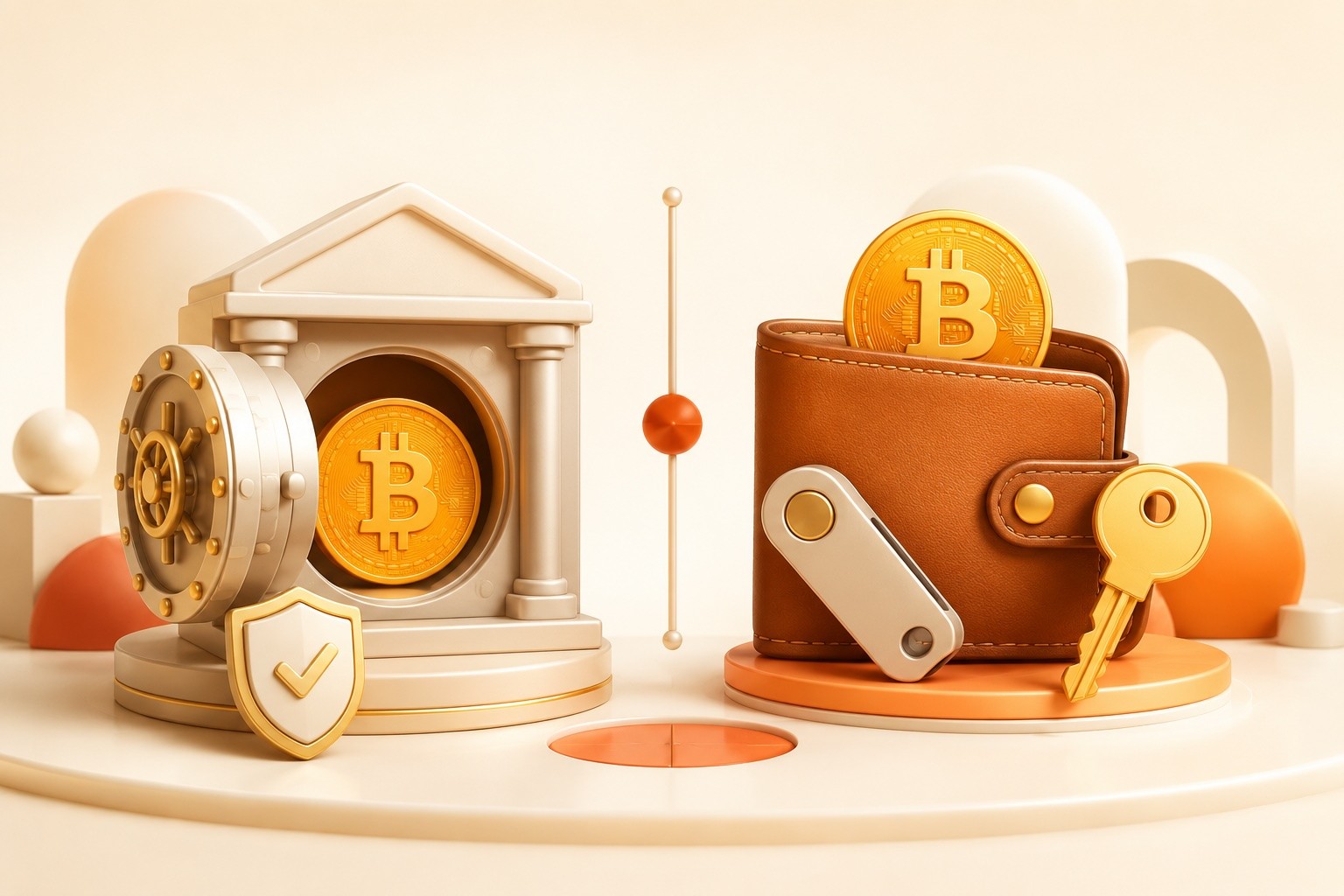
Custodial vs Self-Custody Bitcoin Wallets: Who Actually Holds Your Bitcoin?
Key takeaways
A custodial bitcoin wallet means a company holds the private keys to your bitcoin. You hold an account; they hold the asset.
A self-custody bitcoin wallet means you hold the private keys yourself, usually backed up by a 12- or 24-word seed phrase.
The phrase "not your keys, not your coins" is a legal and technical truth, not a slogan. In a custodial bitcoin wallet, you own a claim against the custodian, not the bitcoin itself.
Custodial is reasonable for small amounts, first-time buyers, and active spending. Self-custody is the standard for meaningful long-term holdings.
The safest path for most newcomers is to start custodial, learn the mechanics, then graduate to self-custody in small, tested steps.
What it means when someone else holds your bitcoin
On November 11, 2022, customers of FTX woke up to find their bitcoin frozen. The exchange, which had been the second-largest crypto exchange in the world the day before, had filed for bankruptcy overnight. Hundreds of thousands of people who thought they owned bitcoin discovered they actually owned a claim against a company that no longer existed.
This is the most important question in Bitcoin that almost nobody asks plainly: once you have bitcoin, who actually holds it?
The answer is almost always one of two things. Either a company holds your bitcoin for you in a custodial bitcoin wallet, or you hold it yourself in a self-custody bitcoin wallet. That single fork in the road decides how you own, secure, recover, and ultimately trust your bitcoin. Most people who own bitcoin today have never been asked the question, and so they have never answered it.
Since we started onboarding Bitcoin buyers at Orange Standard, the most consequential decision new customers face is not which exchange to use or when to buy. It is whether, and when, to take their bitcoin into their own custody. This guide is the plain answer to that question, written for the Bitcoin newcomer, with no product pitch attached.
What a Bitcoin wallet actually is (and isn't)
Before going further, clear up the most common misconception about Bitcoin wallets: a Bitcoin wallet doesn't store bitcoin. Bitcoin itself lives on the Bitcoin blockchain, a public ledger replicated across tens of thousands of computers worldwide. A wallet stores the private key, a piece of cryptographic data that proves you have the right to spend the bitcoin associated with a given address.
If you can sign a Bitcoin transaction with the private key, you own the bitcoin. If you can't, you don't, regardless of what an app screen tells you your balance is.
That distinction is the whole game. The rest of this article is about who holds the key that does the signing.
How custodial Bitcoin wallets work
A custodial Bitcoin service (Coinbase, Cash App, Kraken, Robinhood, most exchanges, most "buy bitcoin" apps) holds the private keys on your behalf. When you buy bitcoin in the app, the company credits your account in their internal database. The actual bitcoin sits in the company's own wallets, pooled with everyone else's, and the company signs transactions when you ask to send or withdraw.
You log in with an email and password. You recover your account by resetting your password. If you lose access, customer support can help you get back in. From the user's side, it feels like a bank account, because mechanically that is almost what it is. You own a claim against the company, not the bitcoin itself.
The upside of a custodial bitcoin wallet is simplicity. You don't have to learn anything new. If your phone dies, your bitcoin doesn't. If you forget a password, you can reset it. The company handles the security operations (cold storage, key management, anti-fraud, audits) that you would otherwise need to learn yourself.
The downside is counterparty risk. You are trusting the company to actually hold the bitcoin they say they do, to stay solvent, to not freeze your account, and to not get hacked. Sometimes those bets are fine. Sometimes they are not. When they are not, the consequences are total.
How self-custody Bitcoin wallets work
A self-custody bitcoin wallet generates a private key on a device you control: a hardware wallet, a phone app, or a dedicated computer. The wallet shows you a seed phrase, usually 12 or 24 English words (defined by the BIP-39 standard), that can recreate that private key on any compatible wallet anywhere in the world.
Write the seed phrase down. Put it somewhere safe. That is now the only thing that controls your bitcoin. Not an account. Not a password. Not a customer service line. Twelve or twenty-four words on a piece of paper or a steel plate.
When you want to send bitcoin, the wallet signs the transaction locally with the private key and broadcasts it to the Bitcoin network. No company is in the loop. No login is required. No one can stop the transaction, freeze the funds, or reverse it. That includes you, once it is confirmed. You own the bitcoin itself, directly.
The upside of self-custody is total: no third-party risk, no platform that can fail with your money, no jurisdiction that can freeze you. This is what Bitcoin was designed for in the original whitepaper: peer-to-peer electronic cash without a trusted intermediary.
The downside is also total. If you lose the seed phrase, the bitcoin is gone. If someone else finds it, the bitcoin is theirs. There is no reset button. There is no support line. The phrase "be your own bank" is accurate, and like any bank, the security operations are non-trivial.
"Not your keys, not your coins": what it actually means
You will see this phrase everywhere in Bitcoin. It was popularized by Bitcoin educator Andreas Antonopoulos around 2016, and it compresses a real legal and technical truth into seven words.
If you don't hold the private keys, you don't control the bitcoin. You hold a promise from the custodian that they will give you bitcoin when you ask. That promise is only as good as the custodian's solvency, security, and willingness to honor it.
Most of the time that promise holds. The moments when it doesn't tend to be catastrophic and concentrated, and they have a recent, well-documented history.
What FTX, Celsius, and BlockFi taught us about custodial risk
Three custodial failures in 2022 made the abstract argument concrete:
Celsius Network filed for Chapter 11 in July 2022. Customer deposits were frozen. The bankruptcy court eventually determined that customers in the "Earn" program were unsecured creditors, not owners of their deposits.
FTX, then the second-largest crypto exchange in the world, filed for bankruptcy on November 11, 2022 in the US Bankruptcy Court, District of Delaware, Case 22-11068. Customer funds had been used for the trading firm Alameda Research. The founder was later convicted on multiple counts of fraud.
BlockFi filed for Chapter 11 two weeks after FTX, in part due to direct exposure to FTX.
In every case, customers who held their bitcoin in self-custody were unaffected. Customers whose bitcoin was on the platform spent months or years in bankruptcy court to learn how many cents on the dollar they would recover.
The pattern has not gone away. The Chainalysis 2025 Crypto Crime Report documented over $2.2 billion stolen from cryptocurrency services in 2024 and continued elevated losses through 2025, with custodial platform breaches making up the largest share of the dollar damage.
This is not a Bitcoin problem. Bitcoin worked exactly as designed throughout each of these events. Blocks kept producing every ten minutes, transactions kept confirming, the protocol never stopped. It was the custodians that failed. Self-custody is the structural solution to a structural risk.
That said: most well-run custodial businesses do not blow up. Treating every custodian as if they were FTX is both inaccurate and unhelpful. The point is not that custodial bitcoin is doomed. The point is that custodial bitcoin carries a category of risk (counterparty risk) that self-custody bitcoin simply does not have, and you should choose with that trade-off in plain sight.
Custodial vs self-custody bitcoin wallets at a glance
| Custodial bitcoin wallet | Self-custody bitcoin wallet |
|---|---|---|
Who controls the private keys | The company | You |
What you legally own | A claim against the company | The bitcoin itself |
How you log in | Email and password | The wallet on your device, optionally with a passphrase |
Account recovery if you forget | Password reset, ID verification | Seed phrase only, no other recovery |
Counterparty risk if the company fails | Total | None |
Risk if you make a mistake | Mostly recoverable | Often not recoverable |
Learning curve | Low | Moderate to high, depending on setup |
Best for | Smaller amounts, active spending, first-time buyers | Long-term holdings, larger amounts, sovereignty-minded users |
When a custodial bitcoin wallet is the right call
The Bitcoin community sometimes treats any custodial use as a sin. We don't. A custodial bitcoin wallet is a reasonable, defensible choice in three specific cases.
You're brand new. You're buying your first $50 of bitcoin to understand how it works. Setting up a hardware wallet first is overkill. Use a reputable custodial bitcoin platform, learn the basics, and graduate when you're ready.
The amount is small relative to your overall finances. If you'd shrug off losing the full balance to a platform failure, the operational overhead of self-custody may not be worth it.
You're actively transacting. If bitcoin is part of how you pay for things week to week, keeping a small spending balance on a custodial payments app is no different from keeping a few hundred dollars in a checking account.
The mistake is defaulting to custodial for long-term, significant holdings without thinking about it. That is where the risk math stops working.
When a self-custody bitcoin wallet is the right call
You should be thinking seriously about a self-custody bitcoin wallet when the amount of bitcoin you hold is meaningful to you, when you are holding for the long term and don't expect to transact frequently, when you want to be insulated from custodian solvency or account freezes, or when you want to teach yourself the operational skills of holding bitcoin properly, because those skills compound over time.
You do not have to be a developer to do this. You do have to be willing to spend a focused afternoon learning, set up a hardware wallet, write down a seed phrase, test a recovery, and follow a few non-negotiable rules about how you store it.
Hybrid Bitcoin custody: multi-signature and collaborative custody
The honest answer is that custodial and self-custody bitcoin wallets are not a binary. The Bitcoin custody landscape has matured into a spectrum.
Single-signature self-custody uses one private key, one seed phrase, one device. The simplest version. Strong security if you handle the seed correctly, complete loss if you don't.
Multi-signature ("multi-sig") self-custody uses two or three keys, where signing a Bitcoin transaction requires more than one. You hold all the keys yourself, distributed across separate locations. If one is lost or stolen, the others can still recover or move the bitcoin.
Collaborative custody is a multi-sig setup where you hold most of the keys and a specialized service holds one as backup or recovery aid. You are still the primary controller; the service is a backstop, not a custodian.
Custodial with proof of reserves is a custodian that cryptographically demonstrates they hold the bitcoin they claim to hold. Better than a custodian that doesn't, but still requires trust in the operational side of the business.
If you're new, single-signature self-custody on a reputable hardware wallet is the standard first step. If you grow into larger holdings, multi-signature or collaborative custody is worth learning. We cover both in our Bitcoin custody pillar.
How to move bitcoin from custodial to self-custody
If you've decided to graduate from a custodial bitcoin wallet to a self-custody bitcoin wallet, the move itself is straightforward, but it should never be done in one shot for any meaningful amount. The discipline is:
Choose a self-custody wallet. For most newcomers, a reputable hardware wallet plus its companion app is the standard starting point. Buy direct from the manufacturer, never from a third-party reseller.
Set the wallet up offline. Generate the seed phrase on the device itself. Do not type it into any computer or phone, ever. Do not photograph it. Do not store it in a password manager.
Back the seed phrase up. Two physically separated locations, ideally on metal rather than paper. One in your home, one offsite.
Test with a small amount first. Send the smallest amount that makes you take it seriously, somewhere between $10 and $100 of bitcoin, from your custodial account to your new self-custody wallet. Confirm it arrived on a Bitcoin block explorer.
Test the recovery. Wipe the hardware wallet. Restore it from your seed phrase. Confirm the test balance reappears. This is the single most-skipped step and the single most important one.
Move the rest in tranches. Do not move your full balance in one transaction. Move in three to five chunks over a few days. If something is wrong, you find out before the whole position is exposed.
This sequence, buy direct, generate offline, back up offline, test small, test recovery, move in tranches, is how every serious Bitcoin holder we work with manages the transition.
How the regulatory picture is changing
Bitcoin custody is no longer purely a personal decision. It is becoming a regulated category. In the European Union, MiCA (the Markets in Crypto-Assets Regulation) took effect in December 2024. MiCA imposes meaningful requirements on custodians (segregated accounts, capital requirements, proof of reserves) and, critically, explicitly excludes self-custodial wallets from its scope. The legal right to hold your own bitcoin is, in MiCA's framing, preserved.
US regulation has moved more slowly but in similar directions: tighter custody rules on exchanges, ongoing debate about how custody is treated for accounting and tax purposes, and a general industry move toward higher transparency.
The practical implication for a Bitcoin holder is that the gap between "well-regulated custodian" and "I hold it myself" is narrowing on the security side but widening on the legal-ownership side. You can have both: a small custodial balance for buying and a self-custody stack for holding. That is what we generally recommend.
Our take, as a Bitcoin-only platform
Orange Standard is Bitcoin-only, and we built our service to make the transition from custodial bitcoin to self-custody as smooth as possible, not to lock you in. Buy on the platform when buying is what you need. Withdraw to your own self-custody bitcoin wallet when you're ready. We'll show you how. That is the standard we hold ourselves to, and it is the standard we think the rest of the Bitcoin industry should be held to.
If you want to start with a small balance and learn the mechanics, buy bitcoin with Orange Standard. If you want to keep learning the fundamentals first, our Learn hub walks through Bitcoin basics in plain English, and our FAQ covers the most common newcomer questions.
Frequently asked questions
Is bitcoin on Coinbase or Cash App self-custody?
No. Bitcoin held in a Coinbase account, a Cash App balance, or any similar exchange or payments app is in a custodial bitcoin wallet. The company holds the private keys; you hold an account with them. To move to self-custody, you withdraw the bitcoin to a wallet whose seed phrase you control.
Which bitcoin wallets are non-custodial?
A non-custodial (self-custody) bitcoin wallet is any wallet where you alone hold the private keys, backed up by a seed phrase you generated and store offline. Common categories include hardware wallets, mobile self-custody apps, desktop self-custody apps, and multi-signature collaborative custody setups. The defining test is simple: if a company can reset your access without your seed phrase, it is custodial.
What happens to my bitcoin if Coinbase or Cash App goes bankrupt?
If a custodial bitcoin platform files for bankruptcy, your bitcoin becomes part of the bankruptcy estate and you become a creditor of the company. Depending on the jurisdiction, account terms, and how the company segregated customer assets, you may recover all, some, or none of your bitcoin, and the process can take months or years. The 2022 failures of FTX, Celsius, and BlockFi are recent examples. Self-custody bitcoin is unaffected by custodian bankruptcies because the bitcoin never sat in the custodian's wallets.
What is a seed phrase and why does it matter so much?
A seed phrase is a sequence of 12 or 24 words generated by a self-custody bitcoin wallet that can recreate your private keys on any compatible wallet. It is the single most important piece of information in self-custody. Anyone with the seed phrase can spend your bitcoin. If you lose it, no one can recover it. Store it offline, in at least two physically separated locations, and never type it into a website or share it with anyone, including a "support agent."
Is a hardware wallet the same as self-custody?
A hardware wallet is the most common way to do self-custody, but they are not the same thing. Self-custody is the principle (you hold the keys). A hardware wallet is a specific tool, a dedicated offline device, that makes self-custody safer than holding keys on an internet-connected computer. You can self-custody without a hardware wallet (using a software wallet on a phone or computer), but for any meaningful amount of bitcoin a hardware wallet is the standard recommendation.
Are hardware wallets the only way to self-custody bitcoin?
No, but they are the standard recommendation for any meaningful amount of bitcoin. A hardware wallet keeps the private key on a dedicated, offline device, so the key never touches an internet-connected computer. Software wallets (phone or desktop apps) are valid for smaller spending balances but expose the key to whatever else is running on the host device.
Can a custodian seize my bitcoin?
A custodial bitcoin platform can freeze your account or restrict your ability to withdraw under court order, regulatory action, sanctions enforcement, or internal compliance review. They control the keys, so they control the movement. Self-custody bitcoin cannot be seized by a custodian because no custodian holds it. Though law enforcement can still seize self-custody bitcoin by compelling you to surrender the seed phrase or seizing the hardware that holds it.
Can I lose my bitcoin in self-custody?
Yes. Loss in self-custody is almost always one of three causes: losing the seed phrase, having the seed phrase stolen, or signing a transaction you shouldn't have (often a scam). All three are avoidable with discipline. None of them are mysterious. The operational skills required to avoid them are learnable in an afternoon and reinforced by practice.
Should I move all my bitcoin to self-custody right now?
Not necessarily, and not all at once. The standard advice is to set up a self-custody bitcoin wallet, test it with a small amount first to confirm you can receive and recover correctly, and then move larger amounts as your confidence grows. The first $50 you move teaches you more than reading ten guides will.